


Curriculum Framework
Digital Literacy and Technologies
Technology is rapidly reshaping our daily lives. Proficiency in navigating, engaging with, and working within the digital environment is essential for learners’ future success. As a result, educational systems are evolving to meet these changes.
Digital education in New Brunswick is grounded in the following principles:
- Technology should support and enhance pedagogy and curriculum outcomes.
- Technology skills exist on a continuum. All learners and teachers are capable of enhancing their technology skills.
- Digital and AI tools should enhance, not replace, human thinking and creativity.
- Ethical, safe, and responsible participation in digital environments is essential.
- Students require balanced opportunities to use, understand, create with, and critically examine digital and AI technologies.
- Digital literacy competencies are transferable and enduring, even as specific technologies evolve.
What is Digital Literacy?
Digital literacy is defined as the harmony of digital skills, attitudes, and behaviours that help students achieve their goals and become thoughtful and able citizens that contribute to the betterment of society and the common good. In New Brunswick education, there are six components to digital literacy:
- Digital Citizenship
- Digital Health and Wellness
- Critical Inquiry and Meaning Making
- Creativity, Design, and Problem Solving
- Communication and Collaboration
- Computational Thinking
What is AI Literacy?
AI literacy builds on digital literacy. It develops the knowledge and critical thinking needed for learners to understand, use, question, and apply artificial intelligence. The goal is to develop the foundational understanding required to assess what AI systems can and cannot do and to recognize both their limitations and their potential.
AI literacy includes understanding the social, cultural, environmental, and economic impacts of AI. The goal is to prepare learners, educators, and education leaders to make informed decisions in a world where AI increasingly shapes information, relationships, opportunities, and democratic processes. AI literacy helps learners understand that AI systems are human-designed technologies that require ongoing human judgement and responsibility.
Four modes of learning with AI
A framework for K-12 educational design
*The K–5 Digital Literacy revisions focus on learning about AI and learning without AI. Students will learn age-appropriate ideas about artificial intelligence through teacher-guided activities and discussions. Students will not independently use generative or agentic AI tools in these program blocks.
Artificial intelligence is positioned as an integrated dimension of contemporary digital literacy, supporting all learners in developing the knowledge, skills, and judgement needed to thrive in a technology rich world.
Students benefit from engaging with AI in multiple, balanced ways:
- learning with AI as a support for thinking and creation
- learning through AI-mediated environments such as adaptive tools and simulations
- learning about AI both as a technology and as a subject of critical, ethical, and societal inquiry
- learning without AI to strengthen independent reasoning and skill development
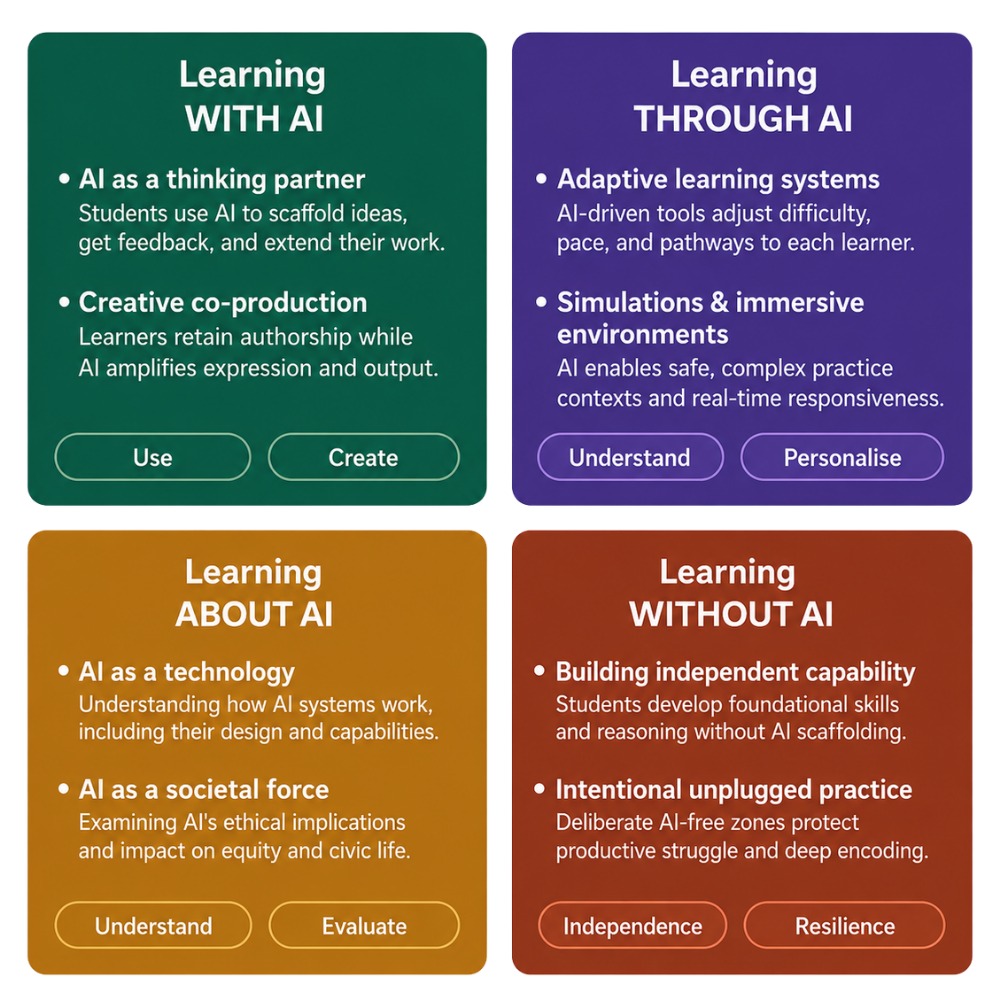
The New Brunswick Digital Literacy Framework articulates what effective integration of digital technology and artificial intelligence looks like in New Brunswick’s K–12 classrooms. It serves as a shared reference point for all education rightsholders as the province advances thoughtful, equitable, and sustainable digital innovation in education.
Enacted in the Curriculum
Looks like
A classroom where digital technology and AI are well-integrated does not look radically different from good teaching. Technology amplifies effective pedagogy rather than replacing it.
Student Experience
- Students collaborative on meaningful, relevant problems rather than passively consuming isolated content.
- They transition smoothly between analogue and digital methods, such as sketching ideas by hand before refining them with digital tools or creating podcasts as part of a novel study.
- Their work is visible, collaborative, and expressed through multiple modes, reflecting diverse forms of engagement and representation
- AI-supported tools offer real-time differentiation in the background by, providing scaffolds, or identifying when a student is stuck without requiring the teacher to manually manage each learner’s needs.
- Students engage in tasks that would otherwise not be possible without technology (e.g., creating videos, podcasts)
Teacher Practice
- Teachers circulate, coach, and engage in deeper learning conversations with individuals and small groups, supported by technology-enabled differentiation.
- Planning time is used to design meaningful learning experiences and engage in ongoing professional learning.
- Teachers use technology to assist with non-teaching tasks, like communication and reporting.
- Assessment moves beyond a single high-stake event, taking forms such as:
- Digital portfolios, where AI assists students in reflecting on their growth over time.
- Multimodal projects where students demonstrate learning through diverse forms of evidence and evaluated throughout the process.
Cultural Responsiveness
- Digital and AI tools are selected and implemented with explicit attention to equitable access across rural, remote, and urban contexts, and to the inclusion of diverse linguistic, cultural, and learning needs.
- Wabanaki ways of knowing are integrated into digital projects, safeguarding authenticity through co-design with the community rather than reliance on generic content.
- Language learners experience their linguistic identities reflected and supported by digital tools, avoiding the limitations of English-default platforms.
Sounds like
Student Voice
- Students compare AI-generated outputs with other sources, questioning how those outputs were produced, and considering issues of accuracy and completeness.
- Students engage in ongoing critical discussions about sources, bias, and whose perspectives are being represented.
- In younger classrooms, students may explain their reasoning first to an AI tool and then to a peer, practicing how to articulate their thoughts in different contexts.
- Students develop the language to describe how digital and AI systems work, their limitations, and when independent human thinking is required.
Teacher Language
- Teachers frame technology as a partner for planning and creating resources, not just a source of content.
- Common language includes, “Let’s use this tool to test your hypothesis” or “Let’s reverse outline this writing to ensure I’ve captured my main idea in paragraph three.”
- The approach shifts from directive to facilitative.
- Teachers model thoughtful, pedagogy-driven decision-making about when technology strengthens learning and when non-digital approaches better support concept development and reflection.
- The focus moves from compliance-oriented tasks to inquiry-oriented learning.
Classroom Atmosphere
- The technology is supporting meaningful conversation, not replacing it.
- Students discuss, debate interpretations, and negotiating meaning with one another.
- Students work effectively across shared digital and physical environments, contributing constructively to shared goals.
Feels like
For Students
- Students experience agency, having choices in how they learn.
- Technology is flexible, adapting to students’ needs instead of forcing students to adapt to the technology.
- The environment feels supportive, with inclusive technology allowing all learners to be successful.
- Students make informed choices about when digital and AI tools best support their learning and when independent thinking is required.
For Teachers
- AI reduces the burden of repetitive tasks such as generating differentiated resources and managing logistics.
- Teachers feel technology use contributes to their professional growth.
- Teachers develop new competencies that expand what they can offer their students.
- Teachers approach integration as an iterative and reflective process, supported by collaboration with colleagues and ongoing professional learning.
For Communities
- Technology serves school and learner priorities.
- Trust is established and sustained among rightsholders.
- Digital and AI tools demonstrate strong data governance and transparent data practices.
- Families understand how and why technology is used in learning.
Common Misconceptions
Digital technologies undermine the role of the teacher.
Technology does not replace teachers; it enhances their work. It enables teachers to design richer, more creative learning experiences and dedicate more time on instruction, relationships, and responsive support. The role of the teacher is likely to evolve with the capabilities that AI in education will bring.
Students only use AI to cheat.
Some students misuse technology, often due to a lack of guidance. When supported to use AI appropriately, students can engage critically, deepen understanding, and improve learning outcomes. AI requires educators to rethink assessment practices.
Learners have grown up with technology and therefore have good digital literacy skills.
Access and experience vary widely. Students need explicit support to develop digital literacy. It is critical to remember that learners need support with understand how to engage with technology in an academic setting, compared to a social setting.
Teachers may use any digital tools to engage learners in the classroom.
Policy 311 states “Only software approved by the Department may be used when the personal information of students and school personnel is to be used or stored in the software”. Anyone looking to employ an app or software should confirm it has been approved before using in a classroom. Districts may apply additional directives.
Screen time is harmful and distracts from learning.
Not all screen time is the same. Interactive, purposeful use supports learning, while passive consumption has different effects. The impact depends on context, quality, and intent.
Coding and computational thinking skills are only valuable to learners in a technology classroom.
Coding and computational thinking develop problem solving, synthesis, and logical reasoning. These skills are critical and transferable across learning areas, including the humanities, arts, and language learning.
Ethical Considerations

Technology, Equity, and Ethical Considerations in Digital Learning
All technology has limitations. At the same time, thoughtfully integrated technology can support greater equity in a classroom by removing barriers to access, offering multiple means of representation and expression, and providing personalized pathways for learners with diverse needs. When engaging in digital learning, educators should consider both the learning goals and the skills being developed, ensuring that technology acts as a scaffold rather than a barrier. Educators are encouraged to approach technology use through the lens of Universal Design for Learning (UDL), which prioritizes flexible, inclusive design from the outset.
Ethical Considerations in Generative AI
Generative AI introduces important ethical considerations that affect learners, educators, institutions, and communities. Supporting a shared understanding of these considerations is foundational to responsible use. These issues are not hypothetical; they reflect real tensions that educators, policymakers, and researchers are actively navigating. These issues include, but are not limited to:
- Generation of biased, ableist, racist, sexist, and/or inaccurate information – Generative AI systems are trained on large datasets that reflect existing societal biases. Outputs may perpetuate stereotypes or produce content that is harmful or discriminatory, even when the prompt appears neutral.
- Hallucinations and factual inaccuracy – Generative AI tools can produce responses that are fluent and confident in tone but factually incorrect, fabricated, or misleading. This is sometimes referred to as “hallucination.” Educators and students must develop the critical literacy skills to verify AI-generated information against authoritative sources, particularly in research, assessment, and decision-making contexts.
- Impact on environment – The energy and water demand of large-scale AI systems are significant. Training and running generative AI models contributes to carbon emissions and draws heavily on water supplies for cooling data centres, raising sustainability concerns relevant to climate education.
- Unregulated development – The pace of AI development often outstrips regulatory frameworks. Learners and educators operating in this environment may encounter tools that have not been subject to rigorous review for safety, accuracy, or appropriateness for use with minors.
- Overreliance for creation and decision-making – Dependence on AI tools for writing, problem-solving, and decision-making risks undermining the development of critical thinking, creativity, and metacognitive skills. Educators should be intentional about when AI use supports learning versus when it may displace it.
- Economic impact – Generative AI raises questions about equitable access (device and subscription costs), workforce disruption (job creation and loss), and the concentration of technological power in a small number of private entities.
- Lack of transparency on data use and security – Many AI tools do not clearly disclose how user data is collected, stored, or used to train future models. This is a particular concern in K-12 contexts, where student privacy protections are paramount.
While it is challenging to fully address these issues, awareness of them is essential to mitigating risk and preventing unintended harm. Educators are encouraged to engage students in critical conversations about these dimensions of AI as part of broader digital and AI literacy development.
(Adapted from Recommended-Approaches-to-Generative-AI.pdf, 2024)
Tools and resources
Tools
The following tools are available through EECD:
| Tool | User | Link |
| Microsoft Copilot Chat | All users with @nbed.nb.ca | Copilot.microsoft.com |
| Microsoft 365 | All users with @nbed.nb.ca or @nbss.nbed.nb.ca | Office.microsoft.com |
| D2L Brightspace | All users with @nbed.nb.ca or @nbss.nbed.nb.ca | https://nbvlc.nbed.nb.ca/ https://plhub.nbed.ca |
| myBlueprint | All users with @nbed.nb.ca or @nbss.nbed.nb.ca | https://myblueprint.ca |
| SchoolAI | All users with @nbed.nb.ca | https://app.ca.schoolai.com/ |
| Lumio | All users with @nbed.nb.ca | https://lum.io |
| Canva | All users with @nbed.nb.ca or @nbss.nbed.nb.ca | https://www.canva.com |
| Sora | All users with @nbed.nb.ca or @nbss.nbed.nb.ca | SORA |
| World Book Online | World Book | World Book |
| EBSCO | EBSCO | EBSCO |
(Digital Learning – Home, 2026)
Resources
EECD and District Resources
Other Resources
- https://learning-s-site-12cb.thinkific.com/collections/products
- ICTC PD Day ICTC’s PDday.ca | KnowledgeFlow Cybersafety Foundation
- ICTC Cyberbytes Home | ICTC’s CyberBytes
- Learning modules for teachers and students: Adventure into Artificial Intelligence | ChatterHigh
- Media Smarts Teacher Training: Digital Literacy 101
- Media Smarts Teacher Guide to Digital Literacy: classroom_guide_digital_literacy.pdf
- Kids in the Know lesson plans (Canadian Centre for Child Protection): EECD has a licensing agreement for all NB educators. Use NBED credentials to create a free account.
– OECD, Future of Education and Skills 2030The future of education lies in connecting knowledge, skills, attitudes, and values.

For Educators:
- Visit the Digital Learning Hub [NBED] for educator tools and resources.
For Families/Guardians: