


Curriculum Framework
Principles for Assessment and Evaluation
Assessment guides learning. At its core, assessment is a genuine act of kindness as its primary purpose is to provide growth-oriented feedback and the non-judgmental support for learner agency (Gini-Newman, 2023). Designing assessment opportunities that invite learners to engage in rich, meaningful tasks sparks curiosity and inspires learning. Using effective instructional practices through which assessment is woven builds learner capacity to think, innovate, persevere, and become effective problem-solvers (Shepard, 2019). When learners understand the purpose of assessment as guidance, they embrace the value of trying, without fear of failure, and welcome opportunities to reflect, rethink, and revise their responses to challenges as their learning unfolds (Black & William, 2009; Hattie & Timperley, 2007). They also come to see the pursuit of sound answers as valuable, built through critical, creative, and collaborative thinking over performative tasks focused on correctness, compliance and the completion of products.
As caring and compassionate educators, our goal is to help all learners experience success as they engage with the curriculum. Caring is providing guidance and understanding to each individual in ways that will enable a transformative impact (Sparks, et al., 2024). Caring assessment and evaluation is carefully considering the data we gather and evidence we construct to make decisions that will best serve the learner as they move through their educational journey.
Assessment, evaluation, and reporting are inter-related yet distinct tasks.
Assessment: To walk alongside, observe, gather evidence, and provide feedback on what a learner can do now and what a learner needs to do next.
Evaluation: To make a judgment of learning based upon a body of assessment evidence.
Reporting: To communicate learner progress, achievement, and next steps to learners, families and caregivers.
Principles for Assessment and Evaluation
Assessment should help a child become a better learner. These five Principles for Assessment are intended to support classroom-based assessment. They are inter-related and cumulative in effect.
1. Skill Development and Learning Process: Effective assessment is an ongoing, strengths-based process that captures how learners develop and apply foundational skills over time, recognizing the importance of both automaticity and application in supporting deep learning. MORE INFO >
2. Trust and Risk-Taking: Grounded in safe, positive, and trusting learning environments, assessment encourages learners to explore, take appropriate risks, learn from mistakes, and use reflection, feedback, and revision to deepen their understanding. MORE INFO >
3. Feedback Cycles: Learners are active participants in the process through clear learning goals, meaningful dialogue, peer and educator feedback, and self-assessment, building greater agency and independence. MORE INFO >
4. Meaningful Evidence: Assessment draws on a broad body of evidence gathered through multiple methods, rather than relying on single-point demonstrations, and uses clear success criteria to support fair, valid, reliable, and transparent decisions about achievement. MORE INFO >
5. The Whole Learner: By considering each learner’s unique strengths, experiences, cultures, interests, goals, and ways of demonstrating understanding, assessment provides a more holistic and responsive picture of learning. MORE INFO >
Lessons from Wabanaki Perspectives
Wabanaki Wholistic Learning in the Principles of Assessment and Evaluation
The Principles of Assessment and Evaluation have been shaped through close consultation with Wabanaki Elders, Knowledge Keepers, and educators from across Wabanaki homelands. Each of the five Principles for Assessment has been influenced by Wabanaki Perspectives.
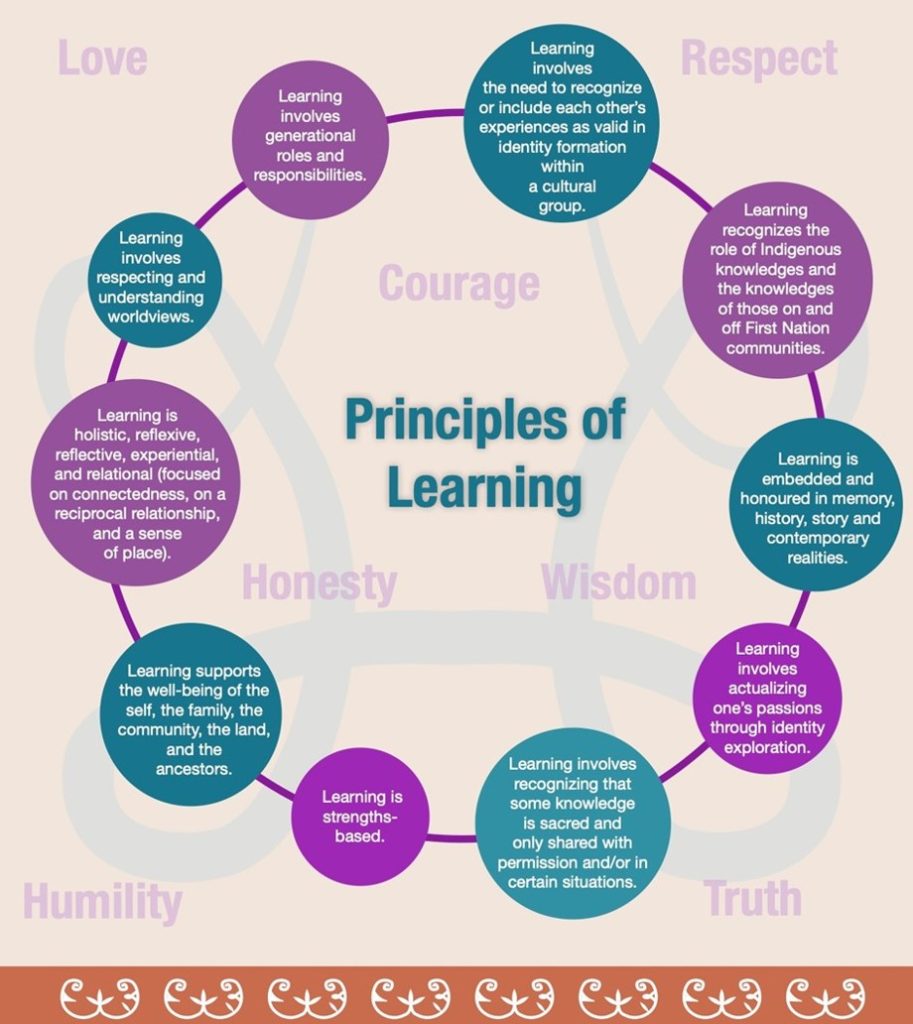
As Elders have taught us, for Wabanaki Peoples, the processes of learning, teaching, creating, and assessing are more holistically integrated than in traditional, Euro-Western approaches. At the core is the goal of helping learners to be whole, happy, and successful, and to live respectfully toward all. These perspectives are highlighted through the Wabanaki Principles of Learning (see graphic above).
Each of these connections is linked through the five Principles for Assessment. Educators may find that they are already drawing from Wabanaki holistic practices in their assessment strategies, as these practices become increasingly common in education.
Assessment in a Digital Age
There are several opportunities and considerations to keep in mind in the context of assessment practices in this digital age. Technologies and digital tools – including generative artificial intelligence (GenAI) – can enhance planning and assessment for educators and help learners to develop skills in deep and meaningful ways (Tran et al, 2026). When these tools are applied deliberately, ethically, and with intent, educators and learners can both benefit (Ma & Zhong, 2025; Tran et al, 2026).
Effective assessment and evaluation practice is aligned to curriculum learning goals from planning to final evaluation and reporting. Digital tools can help educators to keep this alignment central to their planning and ensure that learning activities and assessments reinforce learning goals. Digital tools can create opportunities for educators to create rich, authentic assessment tasks and for learners to access multiple modes of representing their learning (Bray, et al., 2023). As educators consider the whole learner in assessment and evaluation, digital tools can be helpful to individualize and differentiate learning opportunities, ensuring that learning is meaningful and accessible to each learner. This may involve using digital tools to align assessment contexts with learners’ Career Life Plans or to identify opportunities to highlight cultural connections and perspectives in assessment.
Assessment practices must evolve in response to the growing presence of generative artificial intelligence, as many traditional assessment tasks can now be completed wholly or partially through AI tools rather than demonstrating a student’s own learning. Current research suggests that educators should redesign assessment to focus on authentic demonstrations of understanding, critical thinking, process documentation, and appropriate human-AI collaboration, rather than relying solely on finished products that AI can readily generate. Researchers argue that assessment design must adapt to technological change to maintain validity and integrity. At the same time, UNESCO recommends revisiting assessment approaches to ensure they continue to provide meaningful evidence of student learning in an AI-enabled world.
Post-plagiarism
Post-plagiarism (Eaton, 2023) refers to an era in which advanced technologies such as artificial intelligence become a normal part of everyday life, including how people teach, learn, communicate, and interact. Central to the concept is the claim that hybrid writing, produced by humans and artificial intelligence together, is becoming prevalent and will soon be the norm, making attempts to determine where the human ends and the artificial intelligence begins futile. Rather than treating this as a detection problem, the framework relocates the ethical question: humans may choose to relinquish control over what they write, but they do not relinquish responsibility for it, and remain accountable for fact-checking, verification, and truth-telling. For systems leaders, the practical implication is that integrity policy anchored on identifying the origin of text is increasingly unworkable, and that attribution, transparency of process, and evidence of learning become the more defensible policy levers.
The Principles for Assessment and Evaluation recognize the importance of skill development and the learning process in addition to any final products or performances. When learners understand from the beginning why they are learning and how they will be assessed, they can work with educators to determine ways of demonstrating skill development and progress. Evidence of learning may include details of how learners used digital tools to reflect on, revise, and extend their work as part of the learning process. Gathering multiple pieces of evidence that demonstrate progress over time is a key part of this process. Educators may use digital tools to provide learners with timely feedback throughout the learning process. In both cases, learners and educators are carefully guiding and reflecting on input and output from any digital tool, ensuring that it meets their standards. It is not appropriate for output to be used without careful consideration from educators or learners (Tao, et al., 2026).
Use of digital tools varies across program blocks and learning areas. In early grades, educators may use these tools in their planning to inform their teaching and maintain strong alignment with curriculum learning goals. As learners progress educators guide them in using these tools for skill development, providing opportunities to critically evaluate the benefits and costs of digital tools and to make informed decisions about their use. At all ages, educators carefully monitor learners’ use of these technologies and refer to the Recommended Approaches for Generative AI.
Learners and educators use technology as a scaffold to support learning, rather than as a substitute for thinking or skill development. Digital tools are selected intentionally, based on the learning goal. For example, translation tools may help a multilingual learner access science content, but using the same tool to translate a text in a French language class could remove an important opportunity to practice the language. Technology is used when its purpose is clear and when it helps learners access, deepen, organize, or communicate their learning.
With any use of digital tools, educators and learners remain responsible for the quality, accuracy, and integrity of the final work. AI-generated content should never be submitted or used without thoughtful review, revision, and approval. Educators and learners must understand both the possibilities and the limitations of digital tools, with educator guidance helping learners use them safely, critically, and purposefully.
Observing how learners select, use, question, and respond to digital tools can also provide valuable evidence of learning. Alongside conversations and products, these observations contribute to a fuller and more reliable understanding of learner progress and achievement.
Ultimately, effective assessment is not about the tool used or the product created. It is about understanding each learner, recognizing growth, and providing the guidance needed to sustain meaningful learning.
references
References
Black, P., & Wiliam, D. (2009). Developing the theory of formative assessment. Educational Assessment, Evaluation and Accountability, 21(1), 5–31.
Bray, A., Devitt, A., Banks, J., Sanchez Fuentes, S., Sandoval, M., Riviou, K., Byrne, D., Flood, M., Reale, J., & Terrenzio, S. (2024). What next for Universal Design for Learning? A systematic literature review of technology in UDL implementations at second level. British Journal of Educational Technology, 55, 113–138.
Eaton, S. E. (2023). Postplagiarism: Transdisciplinary ethics and integrity in the age of artificial intelligence and neurotechnology. International Journal for Educational Integrity, 19, Article 23.
Gini-Newman, G. (2023) Assessment as Kindness. Critical Thinking Consortium Annual Conference.
Hattie, J., & Timperley, H. (2007). The power of feedback. Review of Educational Research, 77(1), 81–112.
Khlaif, Z. N., Alkouk, W. A., Salama, N., & Abu Eideh, B. (2025). Redesigning assessments for AI-enhanced learning: A framework for educators in the generative AI era. Education Sciences, 15(2), 174.
Ma, N., & Zhong, Z. (2025). A Meta-Analysis of the Impact of Generative Artificial Intelligence on Learning Outcomes. Journal of Computer Assisted Learning 41(5): e70117.
Perkins, M., Furze, L., Roe, J., & MacVaugh, J. (2024). The AI Assessment Scale (AIAS): A framework for ethical integration of generative AI in educational assessment. Journal of University Teaching & Learning Practice, 21(6).
Selwyn, N., MacCallum, K., Wang, F., Kohnke, L., et al. (2024). How should we change teaching and assessment in response to generative AI? Perspectives from educators. Education and Information Technologies.
Shepard, L. A. (2019). Classroom assessment to support teaching and learning. The ANNALS of the American Academy of Political and Social Science, 683(1), 183–200.
Sparks, J. R., Lehman, B., & Zapata-Rivera, D. (2024). Caring assessments: Challenges and opportunities. Frontiers in Education, 9, Article 1216481.
Tao, S., Lan, M., Wang, M., & Li, H. (2026). Potential risks of generative artificial intelligence integration into K-12 education: A scoping review. Computers and Education: Artificial Intelligence, 100561.
Tran, P. T. H., Huynh, L., Bien, T. A., Dang, B., & Nguyen, A. (2026). Preparing preservice teachers for generative AI in lesson planning: a process mining study of AI mindset and tool-only training. Journal of Digital Learning in Teacher Education, 42(1), 16–32.
UNESCO. (2023). Guidance for generative AI in education and research. UNESCO.
– Dr. Sarah Eaton, New Brunswick Digital Learning Summit April 2026Instead of trying to catch students cheating, what if we tried to catch them learning?

For Educators: